
AI Integration / Generative Engine Optimisation
Generative Engine Optimisation (GEO)
Being trusted is just as important as being seen.
Why it matters
Online searching has undergone a significant shift
A procurement officer needs a supplier for a new project. A few years ago, they would have typed a query into Google and worked through a page of links. Today, many start by asking an AI assistant such as ChatGPT, Gemini or Copilot to find suppliers, compare them and draw up a shortlist.
The assistant can only recommend what it can read. If your technical specifications, compliance data and service capabilities sit inside scanned documents, images or forms visitors must fill in first, AI tools cannot read them. Your business is left off the shortlist, however capable it is.
Generative Engine Optimisation (GEO) structures your online information so AI search tools can find, verify and recommend your business.
AI and search
Where people now meet AI when they search
52%
of Canadians who use AI turn to it as a search engine.
59% of Canadians used an AI tool in the past month.
77% have actively used an AI platform in the past three months.
Gemini across Google Search
2.5 billion+
people a month see Gemini powered AI Overviews in Google Search
950 million+ people a month also use the Gemini app
CanadaEuropean UnionAustraliaArore works with clients in Canada, France and Australia.
AI apps Canadians use
Share of Canadian adults who used each app in the past three months. The line below each bar shows worldwide users.
- Gemini Google48%
950 million+ app users a month worldwide
- ChatGPT OpenAI47%
900 million+ people worldwide every week
- Meta AI Meta21%
1 billion+ monthly users across Facebook, Instagram and WhatsApp
- Copilot Microsoft21%
150 million+ monthly users across the Copilot family
- Claude Anthropicn/a
No Canadian usage figure or official user count published
Sources: CIRA, Canadian Internet Trends 2026; Research Co., September 2026 (1,008 Canadian adults); Angus Reid Institute, May 2026 (1,842 Canadian adults); OpenAI, February 2026; Alphabet, Q2 2026; Google, 2026 (AI Overviews); Meta, 2025; Microsoft, October 2025.
Last updated 30 September 2026
33%
of people in the EU used generative AI in the past three months.
64% of 16 to 24 year olds used it, nearly twice the overall rate.
Use is highest in Denmark, Estonia and Malta, at 46% to 48%.
Gemini across Google Search
2.5 billion+
people a month see Gemini powered AI Overviews in Google Search
950 million+ people a month also use the Gemini app
AI Overviews appear on just over 20% of searches in Germany
AI apps Europeans use
When people in Europe click a link in an AI app, which app sent them. Share of those website visits, August 2026. The line below each bar shows worldwide users.
- ChatGPT OpenAI79.3%
900 million+ people worldwide every week
- Gemini Google10.8%
950 million+ app users a month worldwide
- Copilot Microsoft3.6%
150 million+ monthly users across the Copilot family
- Claude Anthropic2.8%
No official user count published
- Meta AI Metan/a
Not measured, as it works inside Facebook, Instagram and WhatsApp; 1 billion+ monthly users worldwide
Sources: Eurostat, 2025 (people aged 16 to 74); Statcounter, August 2026; SISTRIX, February 2026; OpenAI, February 2026; Alphabet, Q2 2026; Google, 2026 (AI Overviews); Meta, 2025; Microsoft, October 2025.
Last updated 30 September 2026
72%
of Australians now use AI when they search online.
36% start at least one search a day with an AI assistant.
12% name AI as their main way to find information, up from 5% a year earlier.
Gemini across Google Search
2.5 billion+
people a month see Gemini powered AI Overviews in Google Search
950 million+ people a month also use the Gemini app
81% of Australians notice AI summaries at the top of their Google results
AI apps Australians use
Number of Australians using each app. The line below each bar shows worldwide users.
- ChatGPT OpenAI13.8M
900 million+ people worldwide every week
- Gemini Google9.1M
950 million+ app users a month worldwide
- Meta AI Meta5.6M
1 billion+ monthly users across Facebook, Instagram and WhatsApp
- Copilot Microsoft5.4M
150 million+ monthly users across the Copilot family
- Claude AnthropicTop five
Among Australia's five most used AI tools; no official user count published
Sources: YouGov, April to May 2026 (1,002 Australian adults); Telsyte, 2026; Roy Morgan, 2026; OpenAI, February 2026; Alphabet, Q2 2026; Google, 2026 (AI Overviews); Meta, 2025; Microsoft, October 2025.
Last updated 30 September 2026
The bigger picture
The rise of AI in search
2 billion
people use AI tools, about one in four worldwide
3x
growth in consumer spending on AI in one year
45%
of AI users rank accuracy among the most important factors in choosing a tool
According to Menlo Ventures' 2026 State of Consumer AI report, around 2 billion people now use AI tools, up from 1.8 billion a year earlier. Spending on consumer AI more than tripled, to an estimated US$40 billion.
The same research shows what people now look for. Accuracy and trustworthiness rank ahead of ease of use when people choose an AI tool, and the more people rely on AI, the more they expect its answers to be right.
That is why businesses are structuring their information so ChatGPT, Gemini and Copilot understand who they are, what they offer and why they can be trusted, and can recommend them with confidence.
Source: Menlo Ventures, 2026: The State of Consumer AI, September 2026. Based on a survey of 5,067 US adults; global figures are Menlo Ventures estimates.
What people look for in an AI tool
Share of AI users naming each as a top factor, 2026.
- Accuracy45%
- Trustworthiness40%
- Security and privacy36%
- Ease of use32%
Ease of use fell from 38% in 2025. Source: Menlo Ventures, 2026: The State of Consumer AI (US adults).
How it works
The GEO framework
Arore structures your website so AI tools can read it, check it and quote it, turning it into an open reference library for your products and services.
Map who you are
Arore adds structured data, known as schema markup, to your pages so AI tools understand exactly what your business makes, the services it offers and where it fits in your industry.
Turn data sheets into clear facts
Technical data sheets are rewritten as short, clearly labelled facts that AI assistants can read and quote, making your business the source they cite.
Measure mentions, not just rankings
Alongside keyword rankings, Arore tracks how often AI tools name your business when buyers ask questions in your field.
Keep the right information open
Core product and service information stays open for AI tools to read, while in depth engineering tools stay behind an enquiry form, so they keep generating leads.
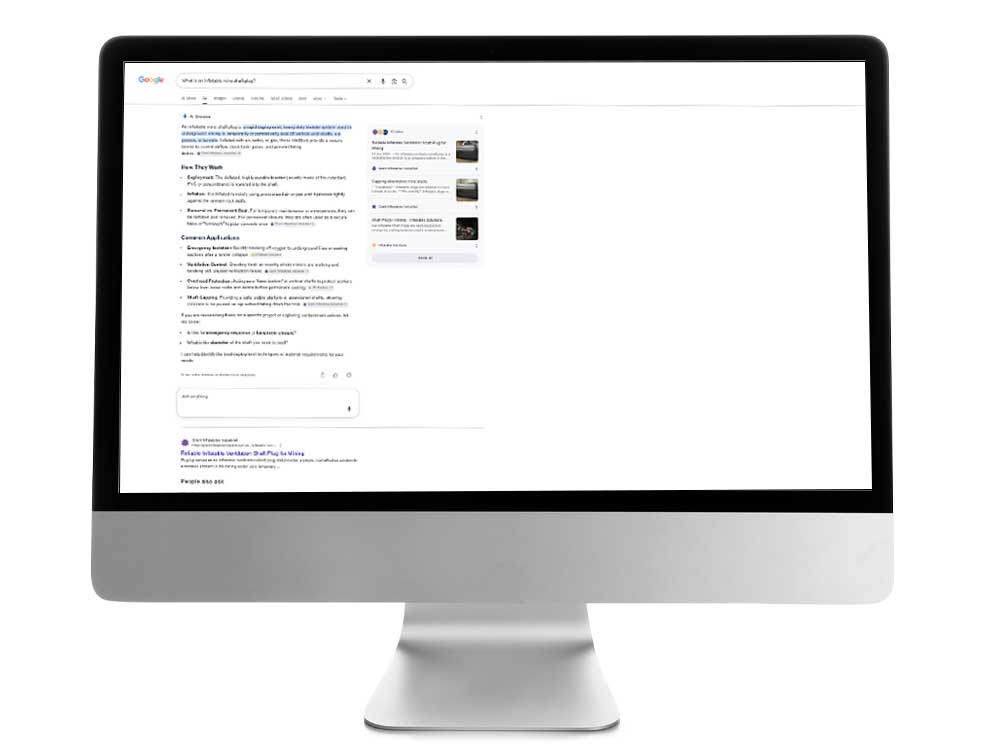
Three places to appear on one search
- 1In the answer itself, named in the AI Overview at the top of the page.
- 2In the sources, listed as one of the websites the answer relies on.
- 3In the results below, as a regular Google listing.
In the answer itself
In the answer itself
27% → 11%
When an AI Overview appears, clicks on the top Google result fall from 27% to 11%. Being named in the answer keeps a business in view.
Source: SISTRIX, February 2026, analysis of over 100 million keywords in Germany.
The EEAT framework
Why trust decides who gets recommended
Trust is now central to being found online. Google's EEAT framework, which stands for experience, expertise, authoritativeness and trustworthiness, describes what makes content helpful and reliable. Google names trust as the most important of the four.
AI assistants face the same test: they need sources they can rely on. Clear, accurate and openly available information about your products and services gives both buyers and AI tools a reason to choose your business.
Arore puts this into practice by making sure your website presents your business clearly, accurately and consistently, in a way both buyers and AI tools can read and trust. Real expertise, presented accurately, supports your visibility over the long term.
EEAT comes from Google's Search Quality Rater Guidelines, which the people who review Google's search results use to judge whether content is helpful and reliable.
- Experience: First hand knowledge of the subject, shown through real projects, products the author has actually used or work the business has actually done.
- Expertise: The knowledge, skills and qualifications of the person or business behind the content.
- Authoritativeness: How widely the business or author is recognised as a leading source of information in its industry.
- Trustworthiness: Whether the content is accurate, honest and safe to use. A secure website, clear contact details and correct information all build trust.
Questions
Frequently asked questions
Do all AI tools use the EEAT framework?
No. EEAT comes from Google's own quality guidelines. Other AI companies don't say they use it, but they all aim to give reliable answers, so the qualities EEAT describes (real experience, expertise and accuracy) help across all of them.
Are OpenAI, Gemini, Microsoft and Meta all AI models?
Not quite. OpenAI, Google, Microsoft and Meta are companies. OpenAI makes the GPT models behind ChatGPT. Google makes Gemini, which is also the name of its assistant. Meta makes the Llama models behind Meta AI. Microsoft's Copilot mainly uses OpenAI's models, and Microsoft has also started building its own.
What is the difference between AI and large language models?
Artificial intelligence (AI) is the broad field of computer science focused on building systems that can do tasks that usually need human intelligence. A large language model (LLM) is one type of AI, trained on large amounts of text to understand and write language. ChatGPT, Gemini and Copilot are all built on large language models.
What is GEO?
Generative Engine Optimisation is the work of making a business's information clear and trustworthy enough to be found, quoted and recommended by AI tools such as ChatGPT, Gemini, Copilot and Meta AI.
How is GEO different from SEO?
SEO helps a website rank in search results. GEO helps it appear inside the answers AI tools give, including Google's own AI Overviews. The two now overlap, since Google's AI features draw on the same search index.
What does EEAT mean?
Experience, expertise, authoritativeness and trustworthiness: the qualities Google uses to describe helpful, reliable content.
How does EEAT affect AI visibility?
EEAT isn't a score, but Google's systems look for signals of those qualities. Content that shows them is more likely to rank well, and so more likely to be quoted in Google's AI answers.
Does GEO replace SEO?
No. They work together. Google says the same search best practices apply to its AI features, so strong SEO foundations support GEO, and GEO adds the clarity and structure AI tools need to quote your business.
Can AI tell when information is wrong?
Not reliably. AI tools can repeat inaccurate information, especially when it appears in several places. The best protection is accurate, consistent information about your business on your own website and elsewhere online.
Why is GEO important?
More buyers now start their research by asking AI tools for answers and shortlists. GEO helps your business be one of the names those tools give.